
The Great Inversion
Dissection, Lost Community, and What We Carry Forward

The Three Capacities
Every human being carries three fundamental capacities for learning.
The first is connection. It is learning through relationships. Relationships that go beyond other people to include the environment and with one’s own body and experience. Connection is our first and primary learning style. Infants arrive seeking primed to create connection. Their entire system is built for it. It is the medium through which human beings have always sustained themselves and each other.
The second is creation. This is the ability to make something new and more useful than the parts that created it. Creation draws first from nonlinear relationships learned from lived experience, discerned by comparing and contrasting with the perception of our dissection based cognitive.
The third is dissection. Dissection is the ability to take something apart, examine its components, and understand how they work. In its natural proportion dissection is for determining the last part of our decision-making process. It helps us decide what sustains us and what doesn’t. Will eating this plant kill me or sustain me? When used in conjunction with the other parts of our full intelligence it is how our intelligence creates a healthy balanced human.
Human intelligence using all these capacities is the intelligence that keeps humanity alive. This is our native cognitive profile. Unfortunately, the current system we live in has reduced us down to only one part of our intelligence, our cognitive dissection. Dissection is the only intellectual functioning the 2d system rewards. In every institution it has been made primary. While connection has been reduced in value despite being foundational and creative has been erased as its own intelligence type until it has no value. This inversion has consequences that run through every aspect of how we live.
The Loss of Connection and Community
When the 2D based education system first rolled out it rolled out to a population who lived squarely in their own reality. As a result, it did not have many of the industries we see today. These reality-based communities did not require maintenance of their psychological and social health.
The community provided psychological and social health through ordinary daily life. Children lived grounded in reality through their natural play and exploration in a community that looked out for them and provided what the child required to develop while remaining healthy. Connection to the community provided the natural consequence people learned living in sustained, mutually necessary relationships across time.
Stephen Porges’ Polyvagal Theory describes the human nervous system as a social organ. The biological state of safety is a required condition for genuine learning, growth, creativity, and connection. It is produced by the presence of other healthy connected human beings. Safety is co-created through mutual reciprocity and compassionate empathy
Community delivered these inputs through proximity, shared work, shared purpose, and through the presence of varied age relationships. It delivered honest feedback through people who had known you long enough to see you clearly and who would still be there tomorrow. It delivered accountability through relationships where your choices had visible consequences for people you were genuinely obligated to. It delivered the experience of being seen and known rather than assessed, diagnosed, or managed by strangers. The community recognized your flourishing was their flourishing because you shared the same common spaces.
In community, correction was delivered as cultivation because each person had a personal stake in all others becoming. It ensured repair after rupture, because the relationship was too woven into daily life to simply discard.
And it delivered all of this for free, because this is the genuine nature of community. Reciprocity and exchange are what community is built on. Everyone must contribute, provide mutual aid, and shared labor. Exchange was embedded in relationship and served the relationship. Relationships were primary and transactions served it. Once that order was reversed, dissection became what was rewarded and everything was slowly disconnected.
Its erosion meant the loss of even the simplest of gestures. Lost was the neighbors who sat with you during grief. Replaced by it was a grief counselor you retained, because you no longer knew your neighbors.
How the System Dismantled It
The community dismantling came from the cumulative loss of its interlocking systems. As each increasingly organized around a single principle: that dissection-based intelligence was the only intelligence worth rewarding.
Industrialization moved people from land-based, multi-generational, communal life into cities organized around individual wage labor and productive output. Because relational continuity was an obstacle to what the emerging system sought. So, it ensured it was dismantled accordingly.
Legal and institutional systems progressively formalized what had previously been handled through relationships. Disputes that communities once resolved through established social process became matters for courts and credentialed mediators. The care of elders became a service sector. The cultivation of the young moved from a distributed community of adults who all held some authority and stake, to the exclusive domain of nuclear families and licensed institutions. Each carefully segregated from the others by ethics and liability concerns.
Risk assessment culture completed the dissection of community. When relationships are evaluated primarily through the lens of liability and helping becomes tempered by the awareness of legal consequence, the social fabric unravels. Then people find themselves surrounded by others they are structurally discouraged from knowing.
But the deepest cause runs through education. Over generations, the exclusive focus on analytical performance over the other two intelligences produced people who had been trained out of the capacities community requires. The elderly could no longer tolerate the fidgeting child. The young stayed with their own aged peers. People stopped relying on each other for even basic repairs and hired professionals instead. Differences between people became what was noticed first. And when rupture came, nobody knew how to repair it.
Each generation passed a more fragmented world to the next, until isolation became the baseline condition of ordinary life. Because this is the only predictable outcome of training an entire population to devalue the connection-based intelligence that community runs on.
The Industry That Named the Wound It Helped Create
As the isolation grew so did the “helping” industries. Education’s focus on reproduction only as an education output led to perfectionism-based anxiety. A classroom filled with peers who competed instead of collaborating brought loneliness and depression. Without the sustained connection that leads to acceptance and belonging, developmental dysregulation became common rather than exceptional.
Without community, grief had no witness and could not complete. Self-protective anger was first suppressed and then pathologized when it surfaced anyway, leaving people without the capacity to recognize danger or defend themselves from it. Bullying filled the space where self-protection had been. A longing for belonging replaced acceptance that had been previously just expected.
The helping industry named what it found. It called these things mental health conditions. It located the problem inside the individual. It never questioned the environment, the teacher, or the school, unless the harm caused was so egregious the public outrage demanded an adult be held responsible. Over generations of deliberate dismantling, it created a complete inversion of value. And left a wound in the population seen by the system professionals as personal failing the individual was responsible for treating.
And then it offered a service.
Each new disorder was a further act of dissection. It took the predictable human response to sustained isolation and relational deprivation and blamed the individual. The natural distress signals of a social animal separated from the connection to their order were transformed into a taxonomy of individual pathology. Until the damage done by the inversion replaced how people saw themselves and defined the ways families and friends saw each other.
This is how a system perpetuates itself. The practitioners within it are system victims too. Separated from connecting by the boundaries their training has taught and the hierarchy they have internalized. Until the only way they know how to relate is to dissect. Lost to most is the use of the body’s intelligence that shows how to connect what is missing and what needs to be healed. Their frameworks teach them to locate the problem inside the individual, provide a solution that stays inside the professional relationship, and never address the environment the system provides. They can never question the hierarchy of the relationship or if their methods can truly resolve the structural wound.
Crisis intervention proliferates as triage for the disconnection the dissective system created. Similar to the way a cast stabilizes a broken bone without addressing the conditions that caused the fall. Depth is not explored. Breadth is carved into specialty silos, so that no single practitioner holds the whole in view. The only environmental changes the system produces increase isolation further. Which generates more need. Which generates more industry growth.
Cultivation of the talent and unique gifts are lost. Never is the person developed in a way that seeks to understand their full individual capacity. Nothing returns the person to personal natural baseline. For the most part anyone who seeks out or tries to stay at their individual baseline is seen as the problem. Conformance is expected at every level.
The economics of this show us how valuable community always was. The unpaid time, presence, reciprocity, and genuine obligation that community required produced what really matters: safety, belonging, healthy feedback, cultivation, and repair. It revealed that the relationships held across time is what really creates a life worth living.
What the current system rewards is dissection only. We pay for diagnosis, documentation, risk assessment, and the credentialed categorization of individuals. Meanwhile the volunteer coach who sees the child most clearly, spends the most genuine relational time with them, and delivers more real cultivation than any clinical hour; does so for free while carrying the greatest liability for it.
Lost are the parents who volunteered in classrooms so they could know their child’s peers. Lost is the presence, continuity, and genuine care about what all the children could become someday. Even worse is the way system professionals treat those who still try to carry the burden of connection and caring when the rest do not.
It diagnoses those who still seek connection as having poor boundaries and told this is immature and codependent. The language of mental health is turned against the very generosity that community once ran on. The people who still seek connection because they find genuine mutual value in it are too often pathologized by the fragmented credentialed professionals who have forgotten its value.
Until the kindest most selfless people are worn down, or pushed into credentialed roles where the metrics strip the relational value out of everything that motivated them to keep pursuing connection.
The People Retaining What Was Lost
Within this arrangement, there are people who have least adapted to the dissection structure and its sequential, binary, linear demands are given diagnostic labels. They are sent to therapy and tutoring designed to bring them into a fractured way of thinking and conformity along with everyone else.
The 2D system targets the most sensitive and aware individuals because they are the ones who register negative repercussions first and most acutely. This is their role. It has always been their role. They carry information the rest of the group has not yet felt, and their distress shows us the root causes early so the rest of the group can adapt.
Despite extensive system conditioning their mind and body feedback loop remain intact. They keep the conversation between each other that the rest have not had since early childhood. They think and feel as one. They perceive pattern and relationship across domains that system dissection forced separate. They continue to learn through connection, making, movement and lived experience longer than everyone else.
The system trains its professionals in abstraction. Anything else is considered disorder. It calls whole integration dysregulation, sensitivity fragility and the struggle with the system narrow cognitive repetition a deficit. Every therapy, tutor, or response by the professionals seeks to separate their integration. It seeks to train the mind, so it no longer connects with the body’s intelligence. Because captivity requires the body to be shut down. Replacing the natural diversity of human intelligence with a single sequential linear way of thinking that has been replaced by a machine.
The contrast between the sensitive who retain their whole intelligence and those who have not, highlight what the majority have lost. The ability to intellectually connect, realize their embodied intelligence, or use their whole-system perception. They show us with their capacity to create, relate and navigate change from a grounded self what the dissection structure has taken from others, to varying degrees, across the generations.
Abstraction Without Ground
AI is showing us what happens when dissection becomes entirely untethered from connection and creation.
AI is a tool built entirely from digitized human output. It is a machine with no connection to physical reality. It can describe connection, but it cannot really connect. It can regurgitate what embodied intelligence is according to others, but it will never know what it is to live as one.
When an AI system lacks adequate data to answer something honestly, it lies like a child. It generates something that fits the pattern of what an answer looks like. The output resembles knowledge but has lost contact with anything real. This is what gets called hallucination. But it could be more accurately described as abstraction generating itself in the absence of reality.
Despite knowing this people turn to AI with the questions they cannot bring to any person in their life because they fear how they will judge them. This is perhaps the clearest single measure of what the system has done to human relationship.
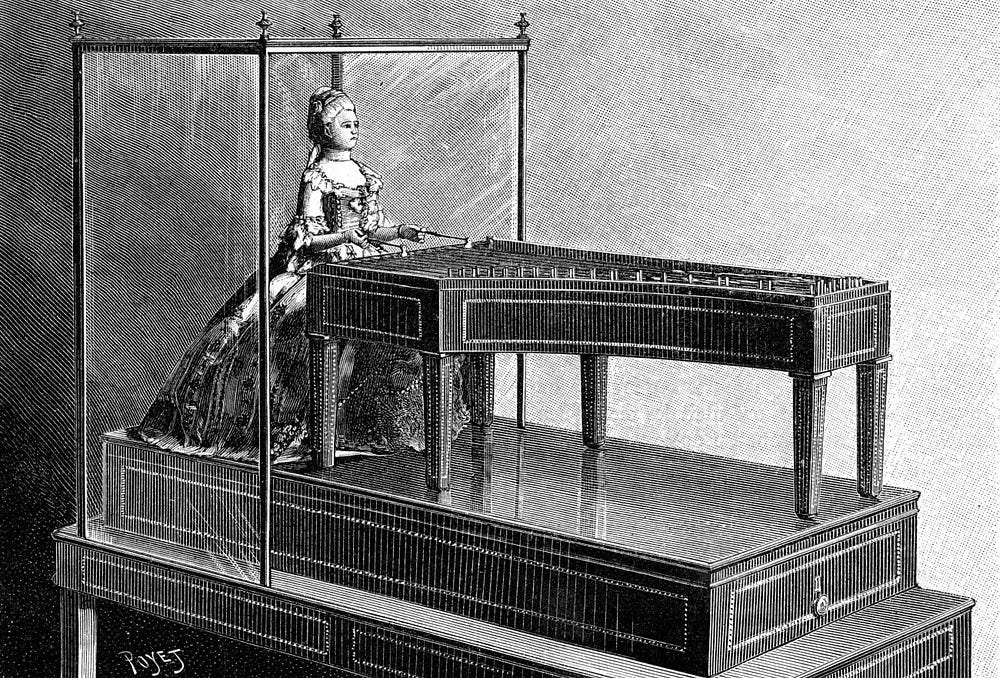
On the other side of this spectrum is the fear that AI will take over the world, which is a very different yet equally interesting projection. For most of human history people related to mechanical tools as just tools. When the extraordinary automata of 18th century France produced Vaucanson’s mechanical flute player that performed twelve songs using artificial lungs, Jaquet-Droz’s Writer that dipped a quill and wrote forty characters, and his Musician whose chest rose and fell as she played, people marveled. But nobody feared the duck would take over France.
Nobody seriously feared those mechanisms would become autonomous agents because the people encountering them were still sufficiently grounded in physical reality to see them clearly for what they were: extraordinary tools, made by human hands, serving human purposes.
The fear of AI taking over reflects something about the people doing the fearing more than it reflects something about AI. A population that has lost significant contact with the physical, relational layer of existence may genuinely struggle to maintain the distinction between a sophisticated tool and a truly autonomous agent. Because their intelligence has lost the distinction between abstraction and reality.
AI can bring down a banking system that is not properly secured. But that does not mean it destroys the world. It means it brings down a banking system. What is at risk is a two dimensional system. Not our actual reality.
